
Which Sudoku Level Should You Print?
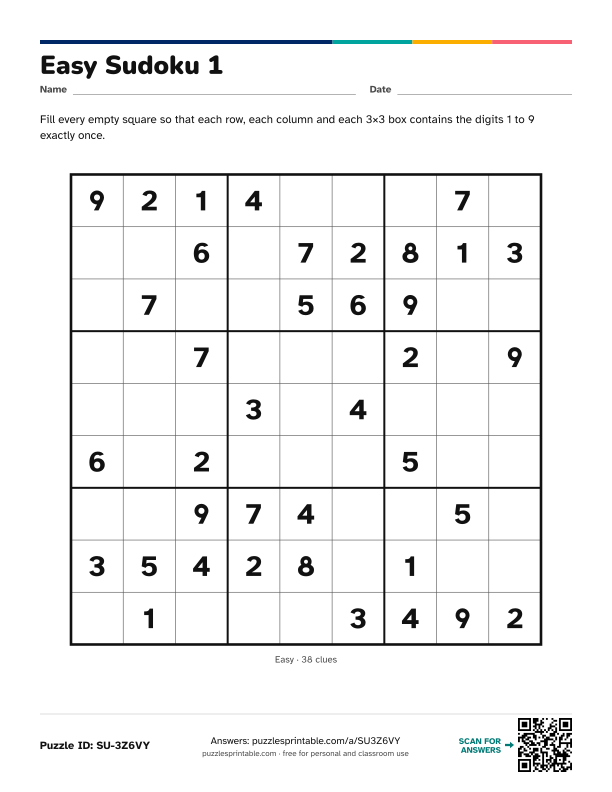
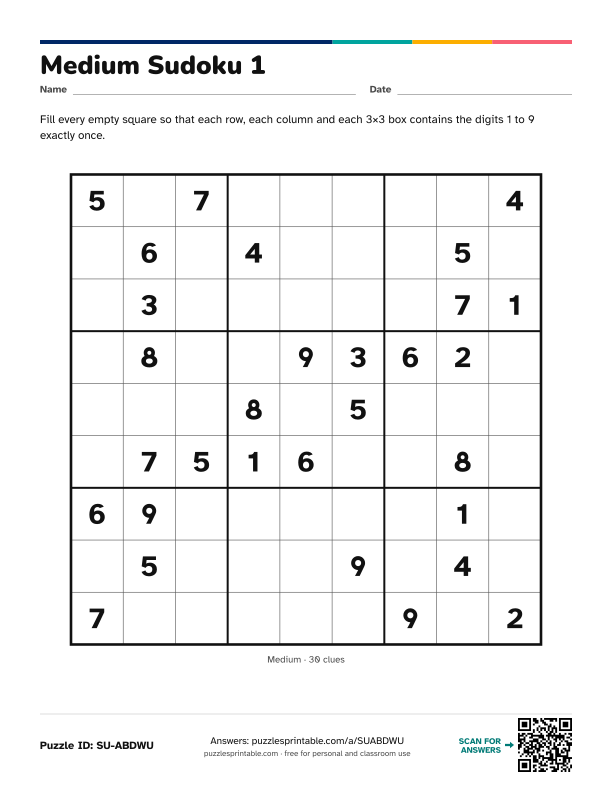
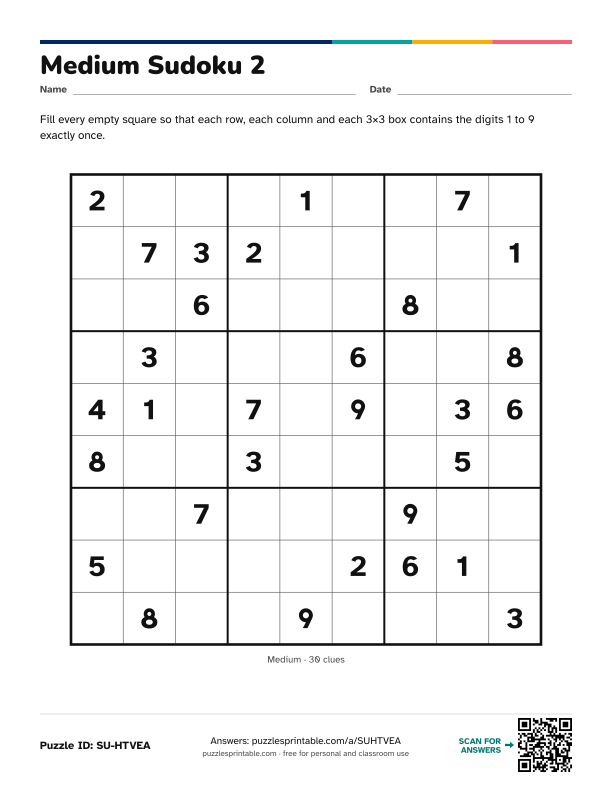
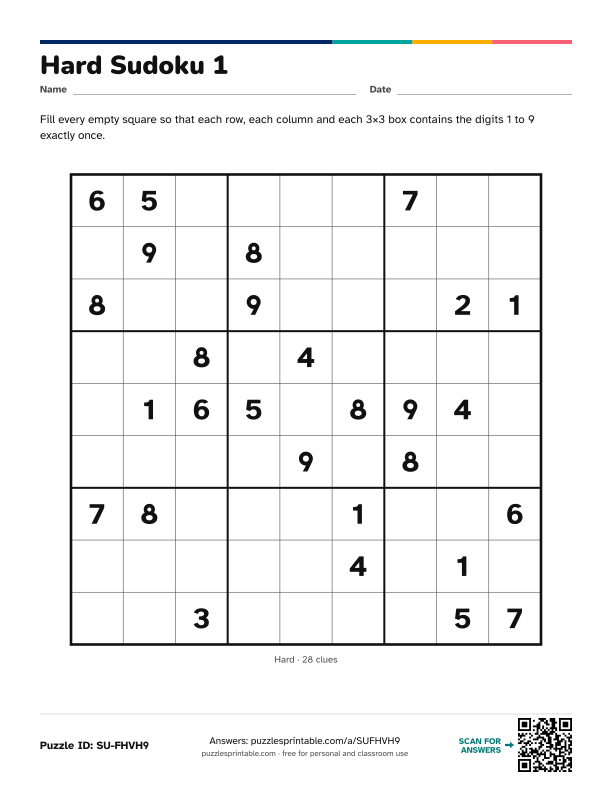
Start with easy sudoku, then move up a level. Each level on this site is set by the solving technique a sheet needs. Easy sheets start with 38 of the 81 numbers filled in. Medium sheets start with 30. Hard sheets start with 25 to 30 numbers and need extra techniques.
| Level | Starting numbers | Techniques needed | More sheets |
|---|---|---|---|
| Easy | 38 | Naked singles: a cell where only one number fits | Easy sudoku |
| Medium | 30 | Adds hidden singles: the only spot for a number in a row, column or box | Medium sudoku |
| Hard | 25 to 30 | Adds naked pairs, pointing pairs and box-line reduction | Hard sudoku |
A computer solver checks every sheet for exactly 1 solution. The starting numbers sit in a symmetrical pattern, the rule Nikoli adopted for sudoku in 1986. For an age group, pick sudoku for kids, sudoku for adults or sudoku for seniors.
What Comes With Each Printable Sudoku?
Each printable sudoku is a 1-page PDF of the puzzle, with the answer key online. The PDF prints on Letter or A4 paper. The "Download PDF" button saves the file, and the "Print" button opens the PDF in a new tab for printing. No sign-up or email is needed.
Answer Key by Puzzle ID or QR Code
The answer key shows the solved 9x9 grid. Starting numbers stay bold and black, and the answers print in gray. Open it from the Puzzle ID or QR code at the foot of the sheet.
One Puzzle per Page
Every sudoku sheet prints one puzzle per page, with the rules printed above the grid. On Letter and A4 paper the standard grid is 6.5 inches (16.6 cm) wide.
Large Print Sudoku
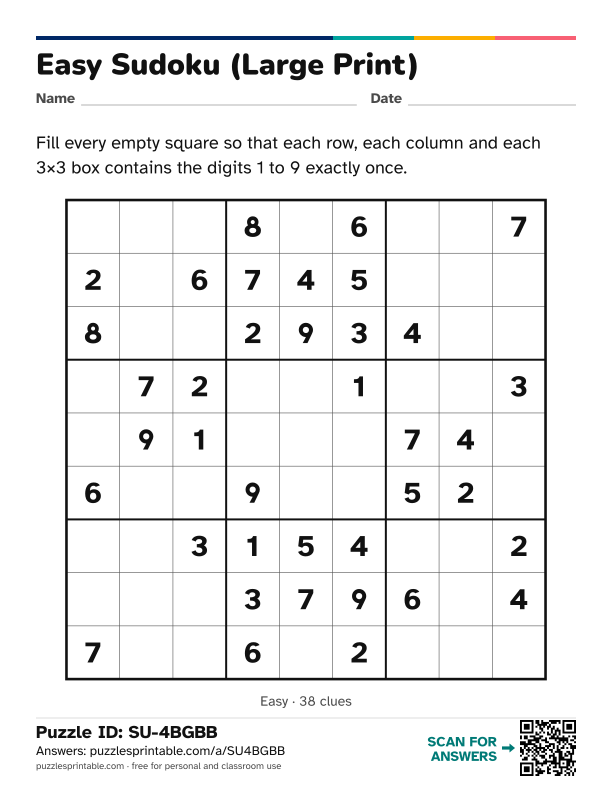
On Letter paper the large print sudoku sheet uses 31.6-point digits in a 7-inch (17.9 cm) grid, against 29.2-point digits on standard sheets. The large print sheet is an easy puzzle with 38 starting numbers. More: large print sudoku and puzzles for seniors.
How Do You Solve a Sudoku?
Fill each empty cell so every row, column and 3x3 box holds 1 to 9 once. Sudoku needs no arithmetic: Encyclopaedia Britannica describes it as based entirely on logic. Solve with 3 repeating checks. Easy sheets need only check 1, medium sheets add check 2, and hard sheets use all 3:
- Scan one empty cell and rule out every number already in its row, column and box. If one number is left, write it in.
- Pick one number and find the only cell in a row, column or box where it fits.
- Pencil small candidate numbers into a cell when no single number fits yet.
The sudoku strategies guide explains the pairs that hard sheets need.
What Is Sudoku and Where Did It Come From?
Sudoku first appeared as "Number Place" in a US puzzle magazine in May 1979. Dell Pencil Puzzles & Word Games printed it with no author's name. Puzzle historian Will Shortz identified the maker as Howard Garns, a retired architect, whose name appeared in the contributor list of every Dell issue with the puzzle.
Nikoli introduced the puzzle to Japanese readers in 1984, and its long Japanese title was shortened to "sudoku": "su" means number and "doku" means single. Wayne Gould, a New Zealander and retired Hong Kong judge, found a sudoku book in Tokyo in 1997 and wrote programs to generate sudoku. The Times of London first printed his sudoku in November 2004.
Grids and Clue Counts
A completed 9x9 sudoku grid has 6,670,903,752,021,072,936,960 possible versions, a count Bertram Felgenhauer and Frazer Jarvis calculated in 2005. A sudoku with one solution needs at least 17 starting numbers. Gary McGuire, Bastian Tugemann and Gilles Civario searched by computer for 16-clue puzzles, found none, and published the proof in Experimental Mathematics in 2014.
What Other Kinds of Sudoku Are There?
Sudoku variants change the grid size or add one rule to the classic puzzle. The sheets on this page are classic 9x9 grids. Encyclopaedia Britannica's sudoku entry, updated in October 2026, lists diagonal, irregular, killer, letter and interlinking-grid versions. The 7 variants below each have their own page:
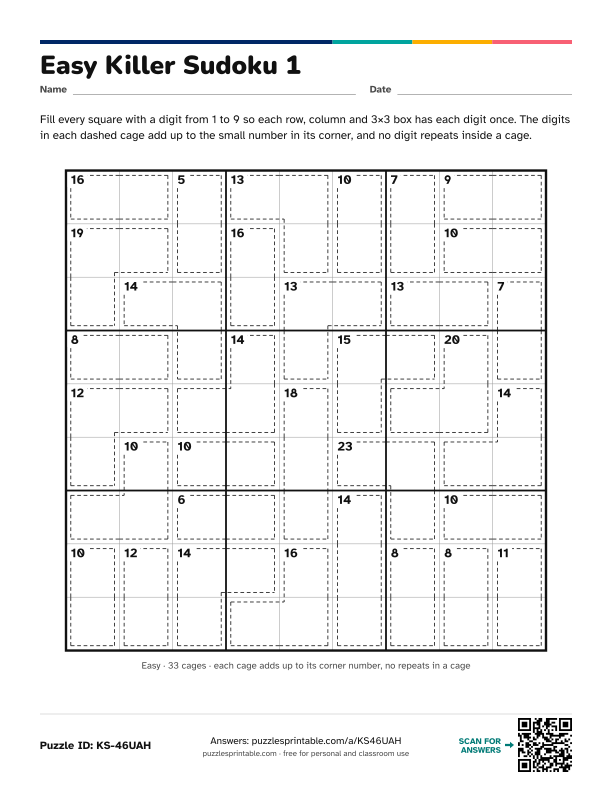
- Killer sudoku adds cages whose numbers add up to a printed sum: killer sudoku.
- Diagonal sudoku also needs 1 to 9 once along each main diagonal: diagonal sudoku.
- Irregular sudoku swaps the 3x3 boxes for other 9-cell shapes: irregular sudoku.
- 4x4 sudoku, also called Shidoku, uses 2x2 blocks and the numbers 1 to 4: 4x4 sudoku.
- 6x6 sudoku uses six 2x3 boxes and the numbers 1 to 6: 6x6 sudoku.
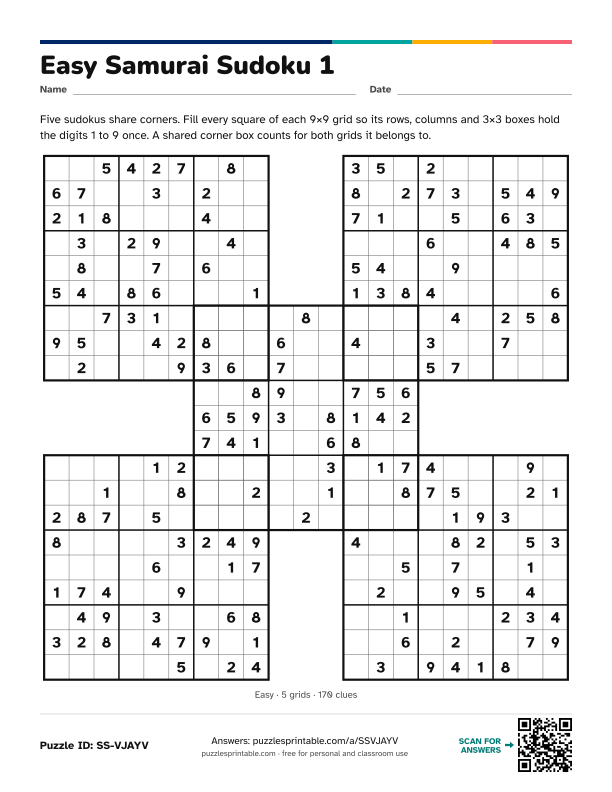
- Samurai sudoku joins 5 overlapping 9x9 grids in an X shape: samurai sudoku.
- Letter sudoku uses 9 letters in place of the digits: alphabet sudoku.
Holiday sheets keep the classic rules: Christmas sudoku, Thanksgiving sudoku and winter sudoku.
What Do People Ask About Printable Sudoku?
Is sudoku hard for beginners? Easy sudoku suits beginners. The easy sheets on this site start with 38 of 81 numbers filled in and need one technique: find a cell where only one number fits. Print 1 easy sheet, check each finished row against the key its QR code opens, and move to medium when easy grids feel quick.
Is sudoku good for your brain? Research shows a link, not proof. Helen Brooker's team (International Journal of Geriatric Psychiatry, 2019) studied 19,078 adults aged 50 to 93. Doing number puzzles more often was significantly related to all 14 cognitive measures. The University of Exeter release names sudoku as one such puzzle. Lead researcher Dr Anne Corbett said they can't say puzzles necessarily reduce dementia risk.
Can I copy these sudoku sheets for my class or group? Yes. The sudoku sheets are free to print and copy for personal use, classrooms, homeschool, libraries, senior centers and memory care groups. Please don't sell these puzzles or upload the files to another site. Share a link to this page instead.
Which Puzzles Can You Print Next?
Crosswords, word searches and word scrambles print the same way. All 3 print on Letter or A4, with answers online by Puzzle ID. Print crossword puzzles with answer keys, word search puzzles for kids and adults or word scrambles with answers. To make your own, start from a blank sudoku grid. All types: free printable puzzles.